
by: TAKWA FUADI SAMAD
Introduction: The Grammar of Sanctuary
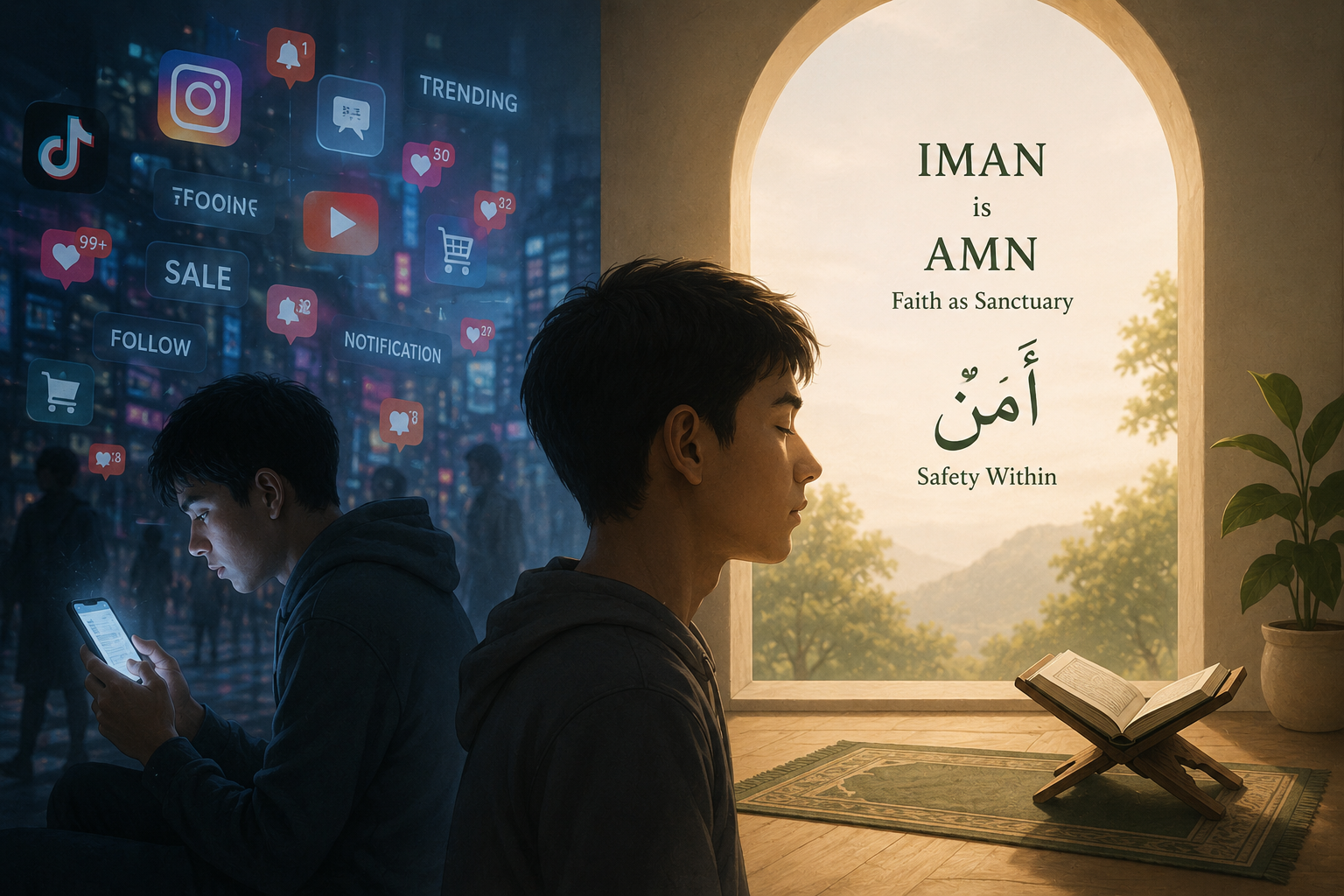
Language does not merely describe reality; it constructs the architecture of human consciousness. In analyzing the psychology of faith, theology often fixates on nouns and doctrines, inadvertently overlooking the humble prepositions that dictate the “spatial metaphors” of our spiritual lives. A profound example of this lies in the Arabic root A-M-N (أ-م-ن), which tethers Iman (faith/belief) directly to Amn (safety/security) and Aamanah (trust). To have faith, in the foundational Semitic sense, is to inhabit a state of safety.
However, when this concept is translated across linguistic borders, its psychological framework shifts entirely. In English, the phrase “faith in” preserves the Arabic spatial psychology; “in” acts as a locative preposition, implying a container, a refuge, or an enveloping sanctuary. Conversely, the Indonesian borrowing of the term, “iman kepada,” introduces a structural distortion. The preposition kepada (to/towards) is directional and objective. While one can naturally say “Iman kepada Allah,” the phrase “Aman kepada Allah” (Safe toward God) feels linguistically broken. Safety is not a destination one points at; it is a space one resides within. By forcing Iman to take a directional preposition, the Indonesian language unintentionally stripped the concept of its inherent sanctuary, projecting God as a distant, transcendent “Other” positioned far across a hierarchical void.
The Loss of Immanence and the Rise of the Digital Refuge
This grammatical shift carries severe theological consequences. True monotheism relies on a dialectical balance between Tanzih (transcendence: God as the Absolute Other) and Tashbih or Qurb (immanence: God as intimately present). The Quranic assertion that God is “closer than the jugular vein” becomes cognitively difficult to grasp when a population’s everyday linguistic hardware constantly forces them to direct their faith away from themselves toward a distant target. Historically, Indonesian spirituality compensated for this distance through the rich, experiential mysticism of Sufism (Tasawuf), which re-introduced intimacy (bi-) and internal feeling (rasa) into the religious matrix.
In the contemporary era, however, this linguistic vulnerability has encountered a devastating adversary: digital capitalism. Today, human orientation and identity are aggressively manufactured from the outside by influencers, content creators, and corporate algorithms. The modern subject is perpetually told where to go and what to consume—whether via TikTok or Shopee—to determine their societal worth.
Because the concept of iman kepada already framed faith as an outward, directional pursuit, the digital market easily hijacked this psychological mechanism. Humans possess an evolutionary craving for Amn (safety). When that safety is no longer found within an immanent Divine presence, it is sought in the collective warmth of the digital crowd. Satiating the fear of missing out (FOMO) by purchasing the right apparel or aligning with online trends has become the new iman—a tangible, instantly gratifying simulation of refuge. In this ecosystem, the algorithm effectively functions as an immanent deity: it is omniscient (via the For You Page), omnipresent (in the palm of one’s hand 24/7), and intimately responsive, rendering the distant, transcendent concept of Ketuhanan Yang Maha Esa (The Absolute One) functionally obsolete in the daily lives of the masses.
Mental Infanticide and the Neurological Deconstruction of Youth
This crisis is not merely a matter of shifting cultural preferences; it is an assault on the biological and cognitive prerequisites of faith itself. Classical theology assumes a fully developed human mental apparatus—one capable of sustained attention, deep contemplation (tafakkur), and the abstract imagination required to engage with the Unseen (Al-Ghaib).
The modern digital environment actively dismantles these faculties. By bombarding children with rapid, hyper-stimulating audio-visual feedback from infancy, algorithms train the developing brain for hyperattention over deep attention. The prefrontal cortex, responsible for long-term contemplation, is bypassed in favor of instant dopamine rewards. Consequently, silence and solitude become unbearable.
This explains why even the most beautifully produced religious content or profound sermons are structurally incapable of competing with viral algorithms. It is an asymmetric warfare of the mind: corporate algorithms weaponize primal evolutionary vulnerabilities (social validation, greed, fear), while spirituality demands an internal stillness that the modern brain has been conditioned to reject. What we are witnessing is a form of mental infanticide—the systemic destruction of a generation’s capacity to harbor depth, meaning, and sacred intimacy.
The Neoliberal State and the Betrayal of the Republic
The tragedy of this cognitive decay is compounded by the structural transformation of the state. The Republic of Indonesia was founded, in part, as a protective shield to safeguard its people from the failure to comprehend the true nature of Ketuhanan Yang Maha Esa. In its earlier, paternalistic iterations—such as the early-to-mid New Order era (1968–1988)—the state actively intervened in the domestic and cultural spheres to preserve the social fabric. Despite its authoritarian flaws, the state maintained strict boundaries: it regulated working hours so parents could remain present in their children’s lives, stabilized the prices of basic commodities, restricted broadcasting hours, and went so far as to censor melancholic pop songs deemed detrimental to the national psyche. The state acted as a paternal bulwark, ensuring that the external environment did not overwhelm the internal sanctuary of the home.
In contrast, the post-authoritarian, neoliberal state has abandoned this protective role. Preoccupied with serving global capital and optimizing macroeconomic indicators, the state has transitioned from a shield to a broker. Parents are economically squeezed by hyper-flexible, boundaryless working hours, returning home mentally and physically exhausted. The state then permits digital conglomerates to enter the bedrooms of these unattended children, turning their attention into a commodity. By abandoning cultural and cognitive safeguards in the name of free-market liberalism, the state has become complicit in the mental infanticide of its own citizens.
Conclusion: The Eskatological Leak
The convergence of a directional linguistic bias, unregulated digital stimulation, and neoliberal state capitulation outlines a precise mechanism for the erosion of faith. It evokes the eschatological prophecy that in the end times, sacred texts will be “lifted” from the hearts of humanity. This lifting is not necessarily the physical disappearance of books or religious apps; rather, it is the destruction of the human vessel’s capacity to retain meaning. The text remains visible on the screen, but the internal architecture required to experience its depth has leaked away through cracks opened by digital trauma.
Faced with a state that has outsourced the souls of its youth to corporate interests, the traditional avenues of institutional reform feel entirely inadequate. If the infrastructure of the digital age is fundamentally engineered to colonize human consciousness, the preservation of Iman as Amn—as a true interior sanctuary—cannot be achieved through sermons or digital campaigns. It requires a radical, physical resistance: the deliberate creation of offline sanctuaries, the reclamation of domestic time, and the grueling work of retraining the human mind to brave the silence, look inward, and rediscover the safety that was lost when we began looking exclusively outward.