
by: BONO BUDI PRIAMBODO
Introduction: The Mirage of the Post-Colonial Transition
The contemporary Indonesian state presents a striking visual paradox to any casual observer. Its urban centers are dominated by gleaming skyscrapers, cutting-edge mass transit systems, and a hyper-digitized population that navigates life through smartphones and e-commerce platforms. On paper, the nation is celebrated as one of the world’s largest vibrant democracies, boasting a rapidly expanding educated class and a skyrocketing gross domestic product. However, beneath this highly modernized veneer lies a structural reality that is profoundly archaic. Decades after the formal departure of colonial powers, Indonesia remains firmly anchored in an economic architecture, a legal logic, and a civic psychology that mirrors its colonial past far more than its democratic promises.
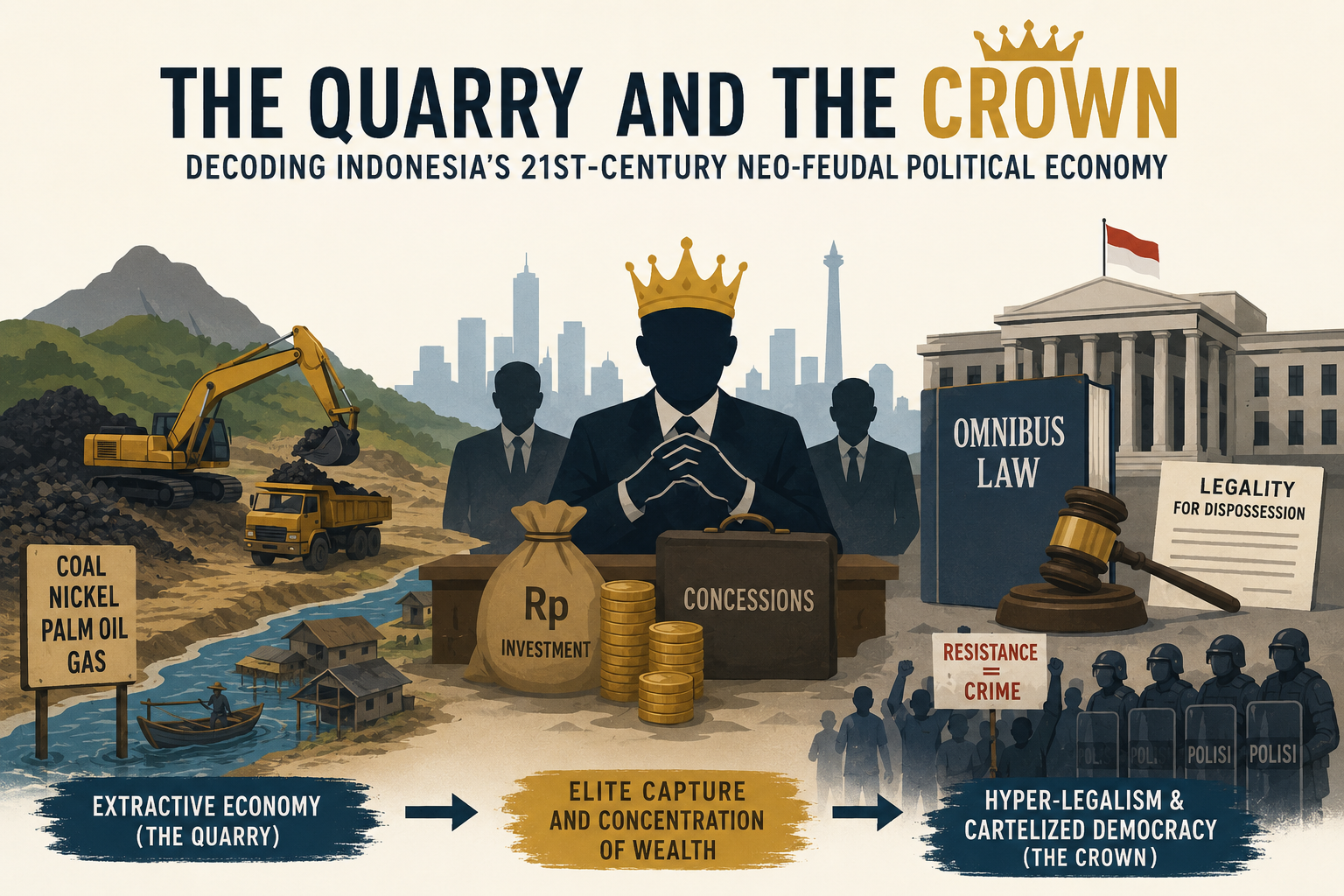
To truly understand the trajectory of 21st-century Indonesian politics, one must move past the comforting narratives of developmentalism and institutional consolidation. Instead, the analytical framework must pivot toward a synthesis of structural political economy, critical legal theory, and historical sociology. By extrapolating localized socio-ecological crises—such as the systemic degradation and displacement observed in coastal governance—onto a macro-political plane, a sobering picture emerges. Indonesia is trapped in a self-reinforcing triadic system: a Columbus-style extractive economic base, a hyper-legalistic yet cartelized political superstructure, and a civic culture deeply saturated by a feudal-peasant psychology. This essay dissects these three pillars to argue that the contemporary Indonesian state functions not as a developing democracy progressing toward maturity, but as a highly sophisticated neo-feudal entity where democratic institutions have been brilliantly co-opted to legitimize the extraction of wealth and the perpetuation of dynastic rule.
The Economic Base: The Columbus-Style Extractive Economy and Internal Colonialism
At the core of Indonesia’s political economy lies an economic model that has fundamentally failed to break free from its colonial lineage. During the era of the Dutch East India Company (VOC) and the subsequent colonial state, the archipelago was designated a “quarry”—a vast territorial expanse from which raw materials were aggressively extracted to fuel capital accumulation in the metropole, while the local population was reduced to a compliant labor force. In the 21st century, the actors have changed, but the structural logic remains completely unaltered. The contemporary Indonesian state relies almost exclusively on an extractive economic engine driven by coal, nickel, crude palm oil, and gas.
This dynamic is perfectly embodied by the phenomenon of aggressive state-led commodity downstreaming (hilirisasi) and the structural prioritizing of Foreign Direct Investment (FDI) above all else. Under the guise of national development and value-addition, ministries function essentially as institutional brokers for global and domestic capital. The state’s primary metric of economic success is the volume of investment attracted and the speed with which natural resources can be converted into capital. This creates what political economists define as an enclave economy. The wealth is violently extracted from the resource-rich peripheries—such as the forests of Kalimantan, the nickel-rich terrains of Sulawesi, and the coastal waters of Maluku—and systematically channeled toward the capital city of Jakarta and global financial boardrooms.
The local populations living in these extraction zones are left to bear the devastating socio-ecological externalities: ruined traditional livelihoods, poisoned water tables, and degraded ecosystems. This relationship between Jakarta and the outer regions is nothing short of internal colonialism. The post-colonial state has simply stepped into the shoes of the colonial governor-general, viewing the vast geography of the archipelago as an infinite repository of spoils to be distributed to concession-hunters.
Crucially, this extractive base requires a specific type of domestic population to sustain itself. Because the economic model prioritizes raw extraction and low-skill processing over high-value technological innovation or a robust knowledge economy, the state does not invest heavily in building a highly skilled, independent workforce. Instead, the 270-plus million citizens are groomed to become a gigantic mass of consumers. The population functions as a captive market for finished, imported goods, kept afloat by consumer credit, digital payment apps, and ride-sharing platforms. This economic architecture strips the citizenry of true resource sovereignty, transforming them into passive market actors whose primary civic duty is consumption rather than political agency.
| Dimension | Colonial Paradigm (VOC / Dutch East Indies) | Contemporary Neo-Feudal Paradigm (21st Century) |
|---|---|---|
| Primary Economic Driver | Spices, sugar, rubber, and forced agricultural labor. | Coal, nickel, crude palm oil, and mineral concessions. |
| Wealth Accumulation Hub | Amsterdam and European financial centers. | Jakarta elite enclaves and offshore tax havens. |
| Role of the Periphery | Exploited colonies providing raw inputs to the core. | Neglected outer provinces bearing ecological destruction. |
| Role of the Population | Forced or cheap labor under racialized capitalism. | A massive consumer market dependent on a predatory gig economy. |
The Superstructure: Hyper-Legalism, Cartelized Democracy, and Neoliberal Governmentality
An extractive economy of this magnitude cannot survive through raw violence alone; it requires a highly sophisticated legal and political superstructure to normalize, legalize, and protect its operations. It is here that critical legal insights become invaluable. Mainstream liberal political science often falls into the trap of treating the law as a neutral, standalone system that can fix societal ills if properly enforced. However, when applied to the macro-Indonesian plane, it becomes obvious that the legal system is not broken; it is working exactly as intended to facilitate oligarchic accumulation.
The contemporary state operates through a mechanism of Hyper-Legalism or Authoritarian Legalism. The regime rarely violates the law in an overt, illegal fashion. Instead, the oligarchic cartel uses its overwhelming parliamentary majorities to simply rewrite the laws to fit their economic agendas. The passage of the Omnibus Law on Job Creation, the systematic revisions of the Mining Law (UU Minerba), and the fast-tracking of the New Capital City (IKN) Law are textbook examples. Through these legislative maneuvers, the state effectively legalizes dispossession. By framing these laws as technocratic, neutral mechanisms aimed at “increasing ease of doing business” or “boosting national competitiveness,” the state strips away the political, moral, and human dimensions of environmental and social destruction. If an extractive project or a massive coastal reclamation is stamped with official state legality, any resistance by local communities or environmental defenders is immediately criminalized as an illegal act or a disruption to “National Strategic Projects” (PSN). The law becomes the ultimate cloaking device to manufacture compliance.