
by: BONO BUDI PRIAMBODO
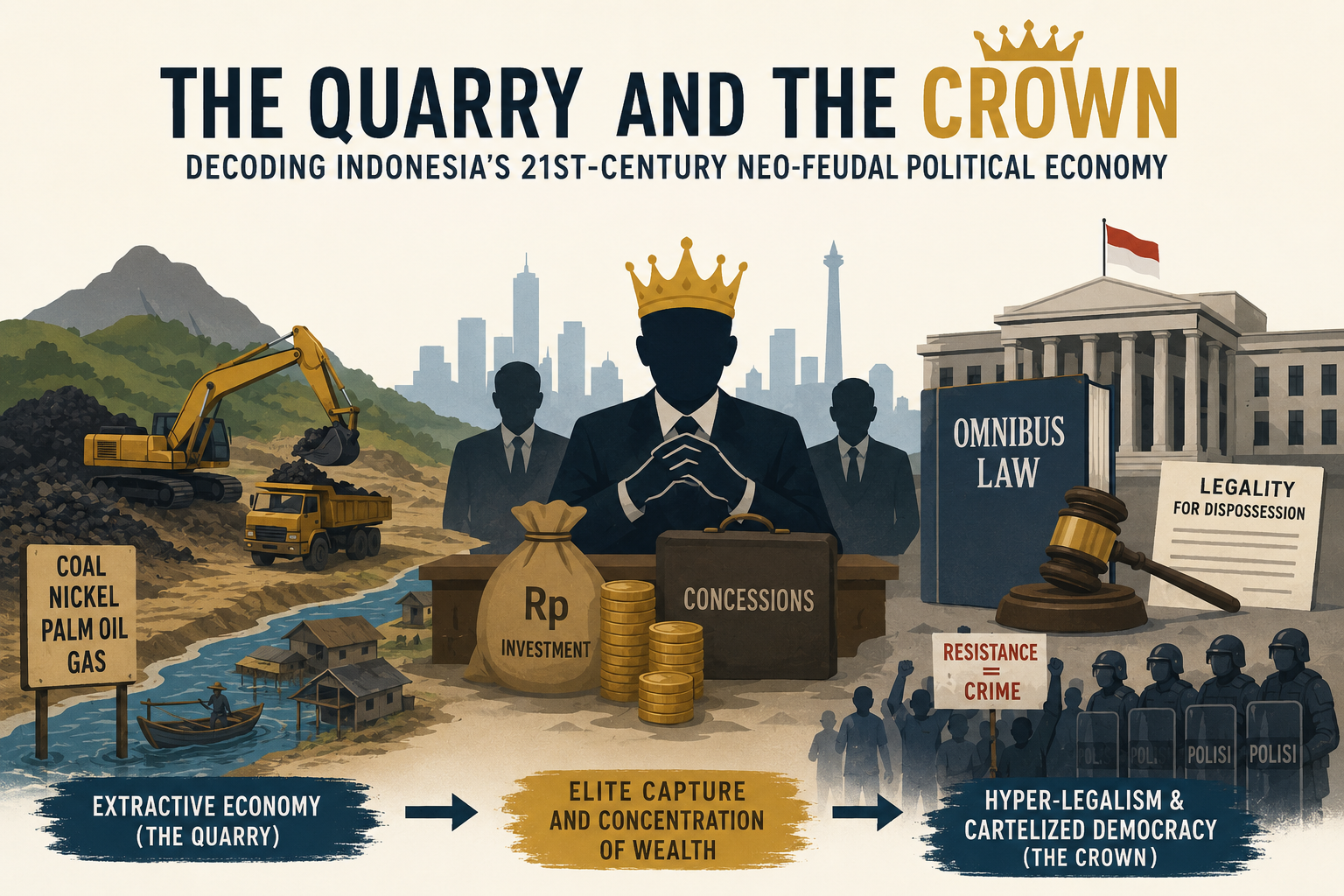
This hyper-legalistic machinery is paired with a highly performative, deceptive model of electoral politics. Every five years, the nation undergoes a massive democratic ritual. The electorate is treated to highly curated, digital, and populist campaigns designed to create the illusion of vibrant political competition and public choice. However, behind this electoral theater lies a deeply unified, cartelized democracy. Because running for public office in Indonesia requires an astronomical amount of capital—to fund campaign infrastructure, media dominance, and extensive patronage networks—candidates are inevitably bankrolled by the very oligarchs who control the extractive economy. Often, the politicians are the oligarchs themselves.
Consequently, elections do not represent a genuine choice between competing ideological visions for the country. Instead, they function as a periodic rotation of power within a unified ruling cartel, serving to renew the lease on the country’s natural resources. The state completely abdicates its traditional duty as the protector of public welfare and the guardian of the commons. Instead, it adopts a fierce logic of neoliberal governmentality. Under this regime, the state shifts the entire burden of survival onto the individual. Citizens are told to be “resilient,” “flexible,” and “entrepreneurial” in the face of economic insecurity and environmental collapse. The state acts not as a guarantor of social rights, but as a corporate board of directors, ensuring that market rationality dictates all human and ecological relations.
The Civic Culture: Feudal Psychology and the Illusion of the Educated Class
The stability of this extractive base and its legal superstructure ultimately depends on the compliance of the population. A profound question arises: why does a population of 270 million people, many of whom are increasingly educated, tolerate a system that systematically extracts their wealth and concentrates power in the hands of a few families? The answer lies in the survival of a deeply entrenched feudal psychology that underpins the modern civic culture.
Despite possessing formal democratic rights, a massive segment of the electorate views political leadership not through the lens of a modern social contract, but through a deeply ingrained, historical model of patronage. The head of state is psychologically elevated from a temporary public servant to a modern-day monarch (Raja). In this neo-feudal mindset, the ruler is perceived as a benevolent patriarch whose legitimacy stems from a unique mix of charismatic power and personal benevolence. When the state distributes social assistance (bansos), it is not seen by the masses as a bureaucratic redistribution of tax dollars to which citizens are legally entitled. Instead, it is interpreted as a personal gift—an act of royal charity—from the benevolent king to his loyal subjects. This generates an intense sense of personal indebtedness and moral obligation among the electorate.
This feudal deference paves the path for the effortless normalization of dynastic politics. When a ruling family positions its children or grandchildren for political succession, the collective response is not widespread democratic outrage, but a quiet acceptance of the natural dynastic order. The public willingly swallows hereditary succession because they have been culturally conditioned to believe that political legitimacy is an inheritable trait wrapped in family lineage. The ballot box, rather than acting as a tool for democratic disruption, is co-opted to give this feudal succession a modern stamp of democratic legitimacy.
This cultural compliance is further enabled by the specific nature of Indonesia’s expanding educated class. While the number of university graduates and credentialed professionals has grown exponentially in the 21st century, this growth has been heavily characterized by **credentialism** rather than the development of critical literacy. The educational infrastructure has been systematically designed to produce compliant, technocratic cogs for the corporate-bureaucratic machinery, rather than independent, critical thinkers. Students are trained to compete for personal survival within the existing framework—striving for civil service spots or corporate positions—which leaves little to no bandwidth for structural critique. Trapped in the daily grind of the neoliberal economy, the educated youth are effectively depoliticized by design. They lack the structural security and the collective solidarity required to challenge the dynastic capture of the state, leaving them as passive observers as the democratic space is locked down by elite cartels.
Conclusion: The Resilient Synthesis of the Quarry and the Crown
When these three planes—the economic, the legal-political, and the cultural—are synthesized, the true nature of the contemporary Indonesian political economy stands exposed. Indonesia’s socio-ecological crises, its legal distortions, and its dynastic transitions are not accidental failures of an unseasoned democracy. They are the logical, highly efficient outputs of a deeply resilient neo-feudal system that has successfully combined the predatory economic goals of colonial extraction with the cultural compliance of medieval feudalism, all wrapped in the modern language of neoliberal law and electoral democracy.
The tragedy of the 21st-century Indonesian state is that it has perfected the art of staying afloat by keeping its population spiritually and economically dependent on the lords at the top. The “sinking” of the nation’s environmental and social fabric is the direct trade-off required to keep the wealth of the oligarchic crown floating. To break this cycle, any future movement for reform must look beyond the naive hope of passing cleaner laws or changing faces at the ballot box. It requires a radical, structural dismantling of the extractive economy and a profound psychological emancipation from the feudal bonds that continue to bind the citizen to the monarch. Until that structural and cultural shift occurs, the archipelago will remain trapped in its ancient colonial cycle: an infinite quarry ruled by a modern crown, powered by a population that has been taught to celebrate its own subjugation.